OpenClaw Wrapper Economy: Architecture & Risk
OpenClaw wrappers are generating $2K–$40K MRR. Technical guide covering architecture, monetization models, and risks.
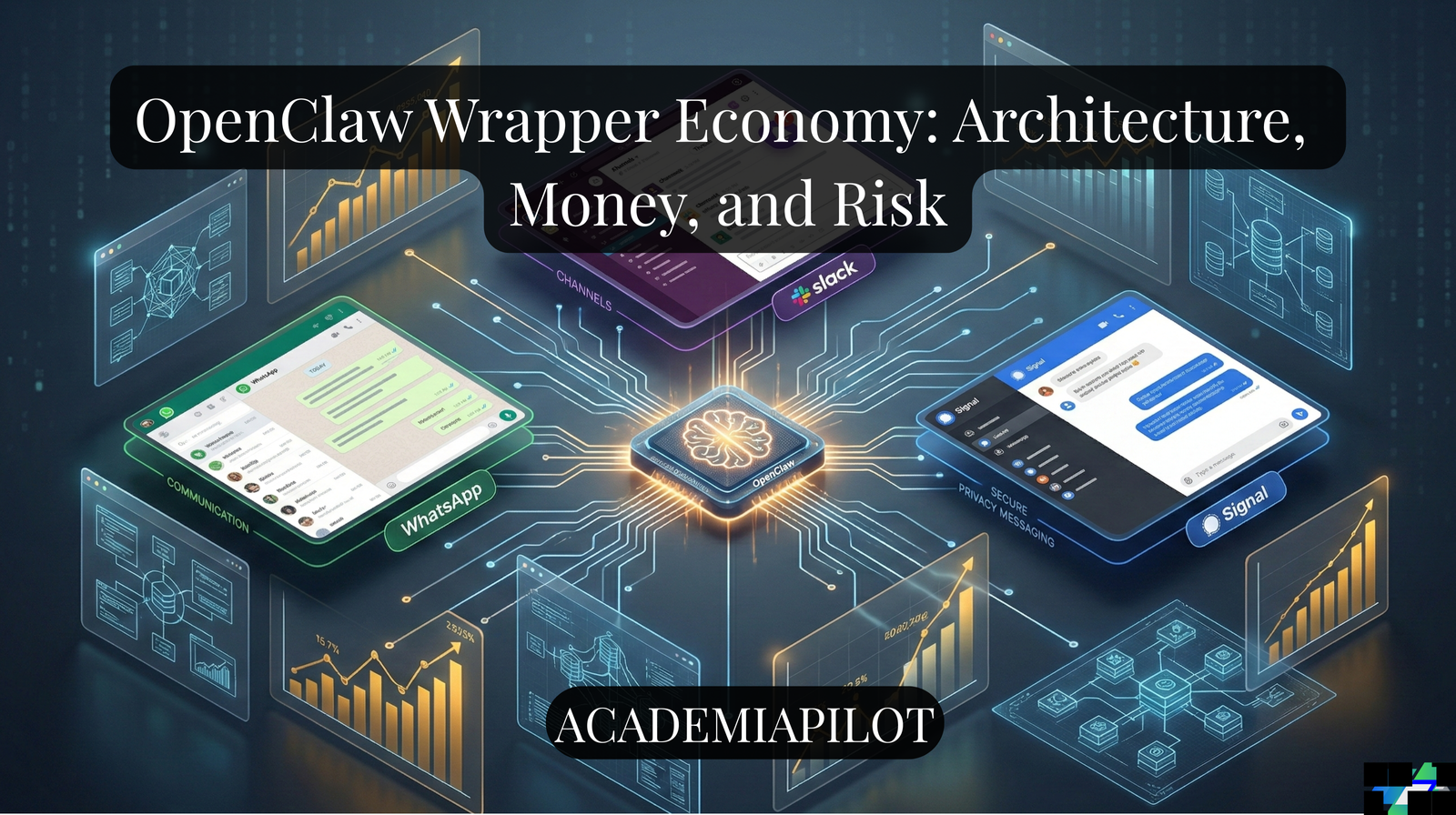
OpenClaw wrapper economy: The ecosystem of SaaS products, managed hosting services, vertical automation tools, and skill marketplaces built on top of OpenClaw — an open-source AI agent runtime. Wrappers abstract OpenClaw's technical complexity into deployable products, generating verified MRR of $2K–$40K per product within weeks of launch.
Strategic Context
OpenClaw is a free and open-source autonomous AI agent developed by Peter Steinberger, designed to execute tasks via large language models using messaging platforms as its primary interface. It became one of the fastest-growing repositories in GitHub history — reaching 150,000+ GitHub stars within 72 hours.
OpenClaw wrappers are reporting $4,779 MRR in 6 days, and verified revenue across multiple wrappers reaching $2K–$39K MRR. Every gap between "OpenClaw exists" and "OpenClaw works for me" is a business waiting to be built.
On February 14, 2026, Steinberger announced he would be joining OpenAI and the project would be moved to an open-source foundation. The commercial ecosystem it spawned — the wrapper economy — is now operating independently of its creator.
What Is OpenClaw? Technical Definition
OpenClaw is not a chatbot. It is a local gateway process that runs on your machine (or a VPS). It acts as a bridge between high-reasoning LLMs and your operating system.
The core differentiator: OpenClaw maintains a persistent identity and memory across sessions, operates through channels users already have open (WhatsApp, iMessage), and executes OS-level commands.
The OpenClaw Architecture — Layer by Layer
OpenClaw is an open-source AI agent framework built around a multi-stage pipeline that routes messages through a Gateway Server, Agent Runner, Agentic Loop, and Response Path.
Layer Deep Dive
- The Gateway (Control Plane): The WebSocket control plane at ws://127.0.0.1:18789 managing clients, tools, and events.
- Channel Integrations: Supported channels include WhatsApp, Telegram, Slack, Discord, Signal, iMessage (BlueBubbles), and Teams.
- Context Assembly: Assembles context from Short-Term Memory, Long-Term Memory (MEMORY.md), and Persona (SOUL.md).
- The Agentic Loop (ReAct Pattern): The core reasoning engine where the agent chains tool calls autonomously until a task is complete.
- Proactive Execution (Cron): Scheduled wake-ups for the agent to monitor feeds or execute tasks without user input.
- Skills (ClawHub): Over 100 preconfigured AgentSkills for shell, file system, and browser automation.
Cost Structure of Raw OpenClaw
Running OpenClaw on cloud LLMs can cost $2 to $75+ per day. The hybrid approach using OpenRouter with model routing is the most cost-effective setup.
OpenClaw Unit Economics: LLM Cost Structure
Running autonomous agentic loops requires high-frequency token exchange. These tiers represent verified production averages.
Claude Haiku
Casual automation, personal task management, and infrequent messaging.
GPT-4o mini
Active business usage, high-volume lead sourcing, and persistent research.
Mix via OpenRouter
Enterprise-grade agentic loops, continuous browser monitoring, and high-frequency tool calls.
Strategy Tip: Use OpenRouter with fallback routing to minimize costs during "Heavy" reasoning phases.
What Is an OpenClaw Wrapper?
An OpenClaw wrapper is a product layer that adds what raw OpenClaw omits: a user interface, authentication, billing, and managed infrastructure.
The 6 Components of a Production Wrapper
Component 1: UI Layer
Browser-based control panel (Next.js/React) replacing CLI with form-driven configuration for channels, SOUL.md, and skills.
Component 2: Auth System
OAuth2/Auth0/Clerk implementation ensuring multi-tenant isolation. Prevents cross-tenant data access at the container level.
Component 3: Billing Hub
Stripe/Paddle integration mapping subscription tiers to instance provisioning. Handles usage limits and API quotas.
Component 4: Key Management
BYOAK (Bring Your Own API Key) or pooled models. Manages model routing to maximize gross margin.
Component 5: Deployment Auto
Docker/K8s orchestration that provisions, scales, and terminates per-user agent instances in milliseconds.
Component 6: Monitoring
Real-time log streaming, token consumption tracking, and error alerting for every active agent instance.
Wrapper Tech Stack (MVB)
- Frontend: Next.js / Tailwind
- Backend: Node.js / Hono / FastAPI
- Auth: Clerk / Supabase
- Billing: Stripe / Paddle
- Infra: Docker / DigitalOcean / Hetzner
Monetization Models: The Revenue Logic
An OpenClaw wrapper is a SaaS platform that lets users deploy their own OpenClaw instance without touching code.
Strategic Priority: Vertical SaaS
The highest-defensible-margin model is domain-specific automation. Candidate verticals include Real Estate Agents (lead sourcing), E-commerce Operators (inventory alerts), and Legal Assistants (document monitoring).
Risk vs. Reward Analysis
Building in the agentic era requires a deep understanding of the risk taxonomy.
OpenClaw Economy: Risk vs Reward Analysis
Product depends on OpenClaw codebase stability & foundation governance.
512+ CVEs documented; malicious skills circulating in ClawHub.
Margins compressed by upstream LLM price changes (OpenAI/Anthropic).
Low barrier to entry; generic wrappers commoditize into $5 VPS offerings.
AI agent data handling & autonomous decisions falling under EU/US AI Acts.
Managed hosting is low; Vertical SaaS with proprietary skills is high.
Strategic Warning: Generic managed-hosting wrappers are expected to fully commoditize by Q4 2026. Vertical specialization is the only path to durable MRR.
The CLAW Execution Framework
A proprietary phased framework for building a defensible wrapper business on OpenClaw infrastructure.
Competitive Comparison
How OpenClaw stacks up against the broader AI and automation ecosystem.
Risks and Strategic Warnings
1. The ClawHub Malicious Skills Problem
ClawHub has a serious security problem. Snyk found 7.1% of the entire registry leaking API keys. Typosquatting campaigns like "ClawHavoc" have distributed macOS malware via malicious skills. Any wrapper operator must whitelist audited skills or build their own review process.
2. Prompt Injection
In an agentic world, Prompt Injection is the new SQL Injection. Mitigation requires running skill execution in sandboxed containers and implementing Human-in-the-Loop (HITL) approval gates for irreversible actions.
3. Known CVE Density
A late January 2026 audit identified 512 vulnerabilities, eight classified as critical. Wrapper operators must maintain private CVE monitoring and apply patches before they are widely publicized.
Mistakes Most Builders Make
The OpenClaw wrapper boom is a masterclass in velocity, but many builders fail at the strategic level.
Critical Strategy: 6 Mistakes Builders Make
Generic Focus
Building a "one-click deploy" for everyone. You are competing with $5 VPS providers. Verticalize or die.
Unrestricted Skills
Allowing users to install arbitrary ClawHub skills. You are importing potential malware into your platform.
Ignoring Token Costs
Using pooled keys without per-user tracking. Heavy users will eat your entire margin in days.
No Fork Strategy
Relying on the upstream canonical repo without pinning a version. One breaking update kills your service.
Underpricing Complexity
Pricing below $29/mo with $15/mo infra costs. Your unit economics cannot support security and support.
Overbuilding UI
Adding analytics and mobile apps before validating that customers are paying and staying.
Future Outlook
The generic managed-hosting market will consolidate around 3–5 platforms within 12 months. Cloud providers will capture the commodity segment. The survivors will be those with proprietary skill libraries and deep domain integrations.
As regulation like the EU AI Act and Colorado's AI Act rolls out, agent systems in regulated verticals (finance, healthcare, legal) will require documented governance frameworks.
The trajectory is clear: The agentic revolution is here, but the winners will be chose who build infrastructure, not just wrappers.
Frequently Asked Questions
Common questions about this topic
Don't Miss the Next Breakthrough
Get weekly AI news, tool reviews, and prompts delivered to your inbox.