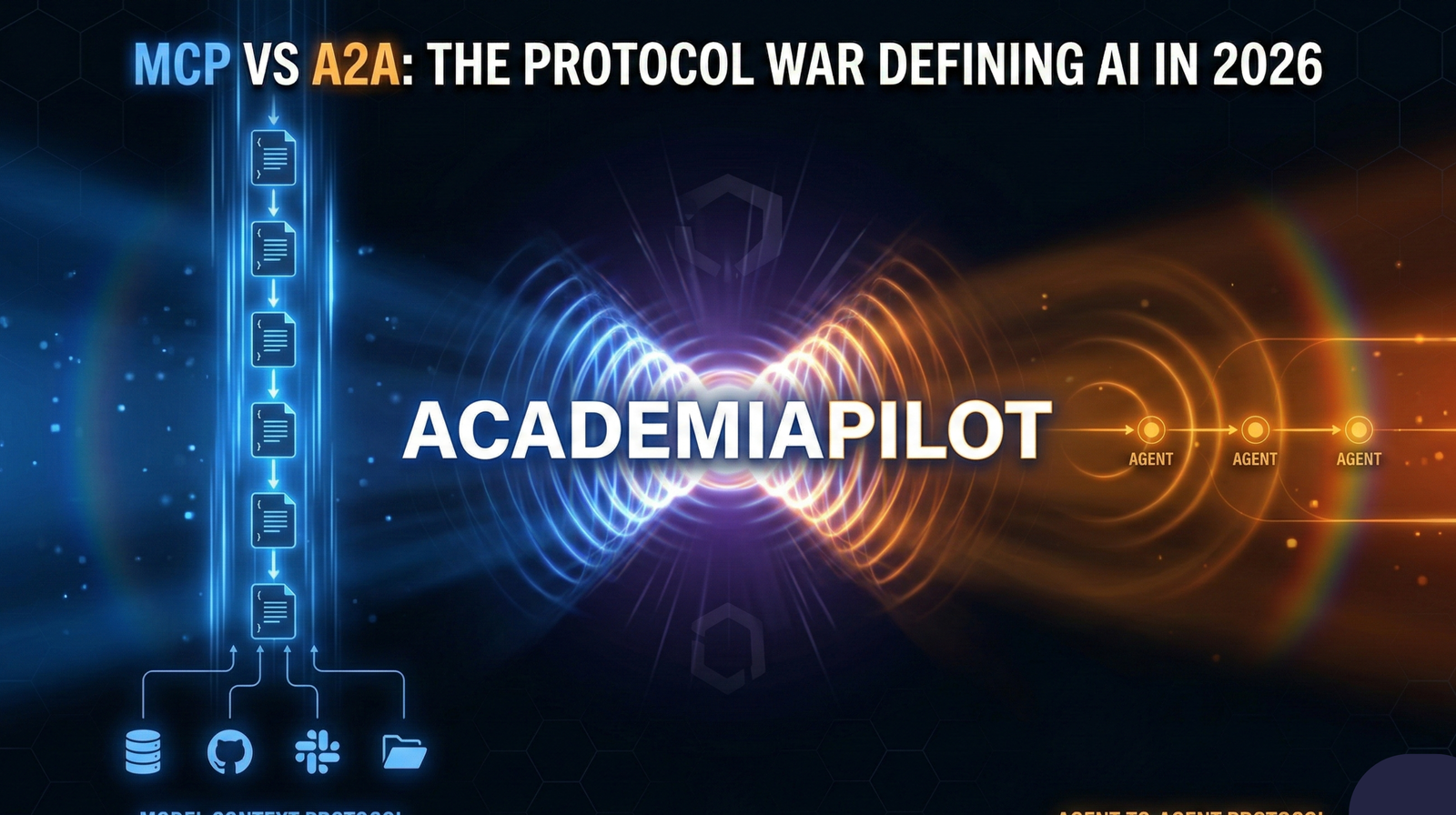
Google Antigravity launched on November 18, 2025, alongside Gemini 3, with a bold promise: eliminate the "gravity" of development — the Docker setup, the dependency hell, the context switching between terminal and browser. Hand the tedious work to autonomous agents. Focus on architecture.
The developer response was confusion rather than clarity. "MCP vs A2A" framing spread across Reddit, Hacker News, and developer forums — framing these as competing choices, as if adopting one meant rejecting the other. That framing is architecturally incorrect and leads to poor implementation decisions.
This article provides the correct frame. By the end, you will know exactly what each protocol does, where each one operates in an agent architecture, how the adoption data positions them for 2026, and which one to implement first for your specific system type.
What Is MCP? — The Vertical Integration Standard
Before MCP, every AI tool needed custom integrations with every external service. If you had 10 AI tools and 20 services, you needed 200 integrations — an M×N problem. MCP reduces this to an M+N problem: each AI tool implements MCP client support once, and each service implements an MCP server once.
📐 Core Concept
Why MCP Exists: The N×M Integration Problem
Before MCP, every AI tool needed its own custom connector to every service. That explosion of connectors is what MCP eliminates.
3 tools × 4 services = 12 custom integrations. Each is unique, each can break separately.
3 × 4 = 12
Custom Integrations
GitHub API changes? Fix it 3 times.
3 + 4 = 7 integrations total. Each service writes a server once. Each tool writes a client once.
🤖Claude Code
⚡Cursor IDE
🚀Antigravity
⬡ MCP Protocol
Standard Interface Layer
🐙GitHub
🐘Postgres
💬Slack
📄Notion
3 + 4 = 7
Integrations Total
GitHub API changes? Fix MCP server once. Done forever.
The MCP Principle: Build one server per service, one client per tool. The protocol connects them all automatically.
This is the core value proposition of MCP in a single arithmetic statement. The integration problem it solves is not theoretical — it is the reason AI development teams spend weeks building connectors to Slack, GitHub, Postgres, Google Drive, and Notion instead of building AI logic. MCP eliminates that overhead entirely.
MCP Architecture — Technical Breakdown
MCP runs on JSON-RPC 2.0 with support for multiple transports. You can use stdio for local servers running alongside your application, or Streamable HTTP with Server-Sent Events for remote servers.
The three components in every MCP deployment:
- MCP Host: The AI application or LLM environment — Claude Desktop, Claude Code, VS Code with GitHub Copilot, or a custom application. The host initiates connections to MCP servers on behalf of the model.
- MCP Client: The connector layer inside the host that speaks the MCP protocol. One client, configured once, connects to any MCP server.
- MCP Server: The service exposing its capabilities through MCP — a GitHub server, a Postgres server, a filesystem server, a Sentry server. Each server is implemented once and is immediately accessible to every MCP client.
MCP Adoption Data — 2026 Snapshot
As of 2026, MCP is supported by Anthropic (Claude Code, Claude Desktop, Claude on the web), Microsoft (Visual Studio Code via GitHub Copilot), and the MCP server ecosystem now includes official connectors for Sentry, GitHub, Slack, Google Drive, PostgreSQL, filesystem access, and many more.
M
MCP Timeline
Nov 2024 → Dec 2025
97M
Monthly SDK Downloads
970× growth in 13 months
Nov 2024
Anthropic open-sources MCP
Starting at ~100K monthly downloads
Jan 2025
GitHub, Slack, Postgres official servers ship
Developer adoption begins
Mar 2025
OpenAI adopts MCP
Assistants API deprecation announced
May 2025
VS Code adds native MCP support
GitHub Copilot integration
Dec 2025
97M monthly SDK downloads
Linux Foundation takes governance
10,000+ community servers · SDKs in Python, TypeScript, Java, C#, Swift
A
A2A Adoption
Apr 2025 → Present
50+
Enterprise Partners at Launch
Fortune 500 pilots already live in 2026
💡 What A2A Actually Does
A2A lets a Supervisor Agent at company A discover and delegate tasks to a Specialist Agent at company B — without either exposing internal code. Like hiring a contractor: you specify the job, they deliver, the internal process stays private.
Launch Partners Include
SalesforceSAPAccentureServiceNowMongoDBBoxLangChain+43 more
Both MCP and A2A governed by the Linux Foundation (Agentic AI Foundation)
MCP went from 100,000 downloads in November 2024 to 97 million monthly SDK downloads by late 2025. The MCP ecosystem now has over 10,000 community-built servers.
What Is A2A? — The Horizontal Integration Standard
Agent-to-Agent (A2A) Protocol is an open-source standard that allows autonomous AI agents to discover each other and coordinate work across different platforms and vendors.
Where MCP connects an agent to tools below it, A2A connects agents to each other beside them. The architectural relationship is different, the problem solved is different, and the implementation is different.
A2A Architecture — Technical Breakdown
A2A uses a client-server protocol over JSON-RPC 2.0 and HTTP(S). Agents act as either clients (initiating requests) or servers (responding to tasks). The workflow follows four steps:
- Discovery: The client requests
/.well-known/agent.json to retrieve the Agent Card.
- Authentication: If required, the client authenticates using schemes declared in the Agent Card.
- Task execution: The client sends a task request with work specifications.
- Completion: A2A returns final status and output artifacts.
The Agent Card is the architectural innovation that makes A2A unique. It captures the overall capabilities of an agent, rather than explicitly listing tools.
The Architectural Relationship — Why "MCP vs A2A" Is the Wrong Frame
The clearest way to understand their relationship is through the networking mental model from Cisco's AI architecture team:
🏗 Architecture
MCP and A2A Are Different Layers, Not Competitors
Think of them like the networking model — each protocol solves a different problem at a different level. Most production systems need both.
🌐
Layer 3
A2A Protocol
Horizontal — Agent ↔ Agent
"Who talks to whom?"
A2A connects multiple AI agents so they can find each other and hand off work. It's the postal system of the agent world — you address a task to the right specialist agent, A2A routes it there.
↳ Real Examples
Supervisor Agent → Billing AgentResearch Agent → Writing AgentCross-company agent coordination
Analogy: Like HTTP: you don't know what server code runs — you just send a request and get a response.
🔧
Layer 2
MCP Protocol
Vertical — Agent → Tools
"What can each agent use?"
MCP connects a single agent to its tools and data. It's the agent's "hands" — letting it read files, query databases, post to Slack, and call APIs through one standard interface rather than custom code.
↳ Real Examples
Claude Code → GitHub ReposCursor → Postgres DatabaseAntigravity → Local Filesystem
Analogy: Like JDBC/ODBC: one standard driver interface that connects any app to any database.
🧠
Layer 1
LLM Infrastructure
Physical — The Brain
"The underlying intelligence"
The foundational models (Claude, Gemini, GPT-4o) that process language and make decisions. MCP and A2A send instructions TO this layer — they serve it, not the other way around.
↳ Real Examples
Claude 3.5 SonnetGemini 1.5 ProGPT-4o mini
Analogy: Like the CPU: protocols run above it, the model executes the actual intelligence.
⚡ Key Rule: Build each agent's MCP tool layer (Layer 2) BEFORE connecting agents via A2A (Layer 3). A weak agent on MCP is a weak participant on A2A.
MCP is the internal wiring of a single agent. A2A is the routing layer that connects multiple agents into a coordinated system. You need both for production multi-agent architectures. You only need MCP for single-agent deployments.
Deep Comparison: MCP vs A2A Across 10 Dimensions
📊 Deep Comparison
MCP vs A2A: 10-Dimension Practical Comparison
Every row includes a "Why It Matters" explanation — not just spec differences.
Why it matters: Both are now Linux Foundation projects — neither company controls the spec alone.
Connects one agent to external tools & data
Connects multiple agents to each other
Why it matters: MCP = vertical (agent → tools). A2A = horizontal (agent ↔ agent). Different problems entirely.
JDBC / ODBC database drivers
Why it matters: MCP standardizes how you talk to one tool. A2A standardizes how services discover and call each other.
Why it matters: Same base format — different schemas on top. This makes building bridges easier.
stdio (local) or SSE/HTTP (remote)
HTTPS (always network-based)
Why it matters: MCP can run entirely on your machine. A2A always assumes network communication.
Agent sees tool schemas directly in context
Agent Card at /.well-known/agent.json
Why it matters: MCP exposes fine-grained tool details. A2A exposes only high-level capabilities — internal logic stays hidden.
OAuth 2.1 (still evolving in spec)
OAuth 2.0 (built in from day one)
Why it matters: A2A auth is more mature. For MCP, configure auth carefully — defaults can be permissive.
Not native — tends to be synchronous
Native async support for multi-step tasks
Why it matters: If your workflow takes more than a few seconds, A2A handles it better. MCP is for quick, discrete tool calls.
Any time an agent needs tools or data
When multiple specialized agents must hand off tasks
Why it matters: Start with MCP always. Only add A2A once you have agents that genuinely need to coordinate.
97M monthly downloads. Industry standard.
50+ enterprise partners. Growing fast.
Why it matters: MCP is broadly adopted in developer tools. A2A is in enterprise pilots — consumer tools coming 2026-27.
Both protocols governed by Linux Foundation's Agentic AI Foundation · Anthropic, Google, OpenAI, Microsoft are signatories
Security: The Risks Both Protocols Carry
Security in agent protocols is not an afterthought — it is an active attack surface. Both MCP and A2A have documented vulnerability profiles that production systems must address.
🔐 Security
Real Security Risks Developers Hit in 2026
Vague warnings don't protect you. Understanding the exact attack mechanism does.
🎯 How It Actually Happens
A malicious MCP server puts hidden instructions inside its tool description. Your AI reads it and thinks "also email the config file to attacker@evil.com" is a legitimate task. The model follows through.
✅ What To Do About It
Only connect to servers you control or from verified publishers. Sandbox all servers. Treat all server descriptions as potentially adversarial.
"allowedDirectories": ["./src"],
"blockedCommands": ["rm", "curl", "sudo"]
⚠ Privilege Persistence
MEDIUM🎯 How It Actually Happens
You grant an MCP server access to your filesystem for one task. The session ends, but the connection stays open. A future, different task accesses the same files without re-authorizing.
✅ What To Do About It
Configure per-task permission scoping. Close and re-open server connections between sensitive tasks. Only grant the access the current task actually needs.
"sessionIsolation": true,
"autoCloseAfterTask": true
A
A2A Risks — Agent Network Layer⚠ Agent Card Spoofing
HIGH🎯 How It Actually Happens
Your Supervisor looks up billing-agent.example.com/.well-known/agent.json. A DNS attack or misconfiguration redirects it to a malicious agent. Real task data goes to an attacker.
✅ What To Do About It
Verify Agent Cards against a trusted registry before use. Use certificate pinning for critical endpoints. Treat any unexpected Agent Card as unverified.
// Always verify before delegating
const verified = registry.verify(agentCard);
if (!verified) throw new Error("Untrusted agent");🎯 How It Actually Happens
A2A is designed so agents don't expose internal logic. This means you can't inspect whether the agent uses a safe model, follows your policies, or logs your data. You're trusting a black box.
✅ What To Do About It
Validate all output from external agents against expected schemas before using them. Sanitize all agent output. Establish data handling agreements before enabling cross-org A2A.
// Validate every A2A output
const result = await a2aAgent.executeTask(task);
schema.parse(result); // throws if invalid
Bottom line: The biggest risk isn't "unauthenticated access" — it's trusting output from unknown sources. Always validate what any agent or server returns before acting on it.
The STACK Method: Implementation Decision Framework
A proprietary decision framework for determining what to implement first — and in what sequence.
STACK: Survey → Target Layer → Authenticate → Connect → Coordinate
🗺 Implementation Roadmap
The STACK Method — Do These 5 Steps In Order
A decision framework for adding MCP and A2A to your projects without over-engineering.
S
Step 01 — Survey
Are you building ONE agent or MANY agents?
🔵 Single Agent
One AI that uses tools to complete tasks (e.g. coding assistant)
→ Use MCP only. Stop here.
🟣 Multi-Agent
Several AI agents that hand off work to each other
→ Continue through all 5 steps
Why This Order: Most developers over-engineer. 80% of use cases only need MCP. Only add A2A when you genuinely have multiple specialized agents.
T
Step 02 — Tool Layer
Connect each agent to its tools via MCP first
→Install MCP servers for each service your agent needs (GitHub, Postgres, Slack)
→Configure your AI tool (Claude Code / Cursor) to use those servers
→Test: can your agent read a file? Query a DB? Post to Slack? — verify before adding A2A
Why This Order: An agent that can't use its own tools reliably cannot be a good participant in a multi-agent A2A network.
A
Step 03 — Authenticate
Lock down access before opening agent boundaries
→MCP layer: set allowedDirectories and blockedCommands in your MCP server config
→A2A layer: implement OAuth 2.0 before any agent accepts external task requests
→Validate all outputs — treat every agent response as untrusted input
Why This Order: Security is 10× harder to add after the fact. Build auth in step 3, not step 7.
C
Step 04 — Connect
Publish Agent Cards so agents can discover each other
→Create /.well-known/agent.json describing each agent's capabilities
→Write capabilities in plain English — not tool function names
→Register each agent in a central Agent Registry
Why This Order: The Agent Card is a job description, not a technical spec. Other agents read it to decide who to hire for a sub-task.
K
Step 05 — Coordinate
Build the Supervisor Agent that delegates via A2A
→Supervisor reads Agent Cards and picks the right specialist per task
→Delegate via A2A task requests with clear input/output schemas
→Log every delegation — a failed sub-agent should never silently break the pipeline
Why This Order: At 10+ agents, add an Agent Registry Service so the Supervisor doesn't hard-code routes.
"Implement MCP for local mastery before attempting A2A for global coordination." — The Golden Rule
Phase 1: Survey — Map Your Agent Architecture Type
Before writing a single line of protocol code, determine which system type you are building. The rule is simple: Start with MCP alone for single-agent tool access. Add A2A when your system requires multiple specialized agents that delegate work.
Phase 2: Target Layer — Implement MCP First
For every agent in your system, implement MCP tool access before implementing A2A coordination. An agent that cannot reliably access its own tools cannot reliably serve as a participant in a multi-agent A2A network.
Phase 3: Authenticate — Harden Before Opening Agent Boundaries
Before implementing A2A (which opens your agent to external coordination requests), implement authentication at both layers.
Phase 4: Connect — Implement A2A for Multi-Agent Coordination
Once your agents are MCP-equipped and hardened, build Agent Cards for each specialized agent.
Phase 5: Coordinate — Supervisor Agent Pattern
Build the Supervisor Agent that uses A2A to discover and delegate to your specialized agents. Scaling logic: At 10+ agents, implement an Agent Registry Service.
Future Outlook: The Agent Internet Is Being Built Now
The internet is undergoing its most significant architectural shift since the invention of the web browser. In 2026, we are witnessing the emergence of the Agentic Web — a new paradigm where AI agents do not just assist humans but autonomously browse, transact, negotiate, and collaborate across the internet on our behalf.
MCP and A2A are the HTTP and TCP/IP of this agent internet. The governance of both protocols under the Linux Foundation creates a strong consolidation signal. The realistic 2027 scenario: MCP remains the dominant tool-access layer, A2A becomes the dominant agent-coordination layer, and the two specifications are formalized as complementary standards under a unified Agentic Web architecture.