Anthropic's AI Labor Market Study 2026: What the Data Actually Shows
Anthropic's Massenkoff & McCrory study plus five Economic Index reports is the most rigorous AI jobs analysis ever published. Computer programmers are 74.5% exposed. 30% of workers show zero exposure. Highly educated workers earning 47% more are most at risk. Entry-level job postings down 35% since 2023. Here is every number as of April 8, 2026 — and what to do about it.
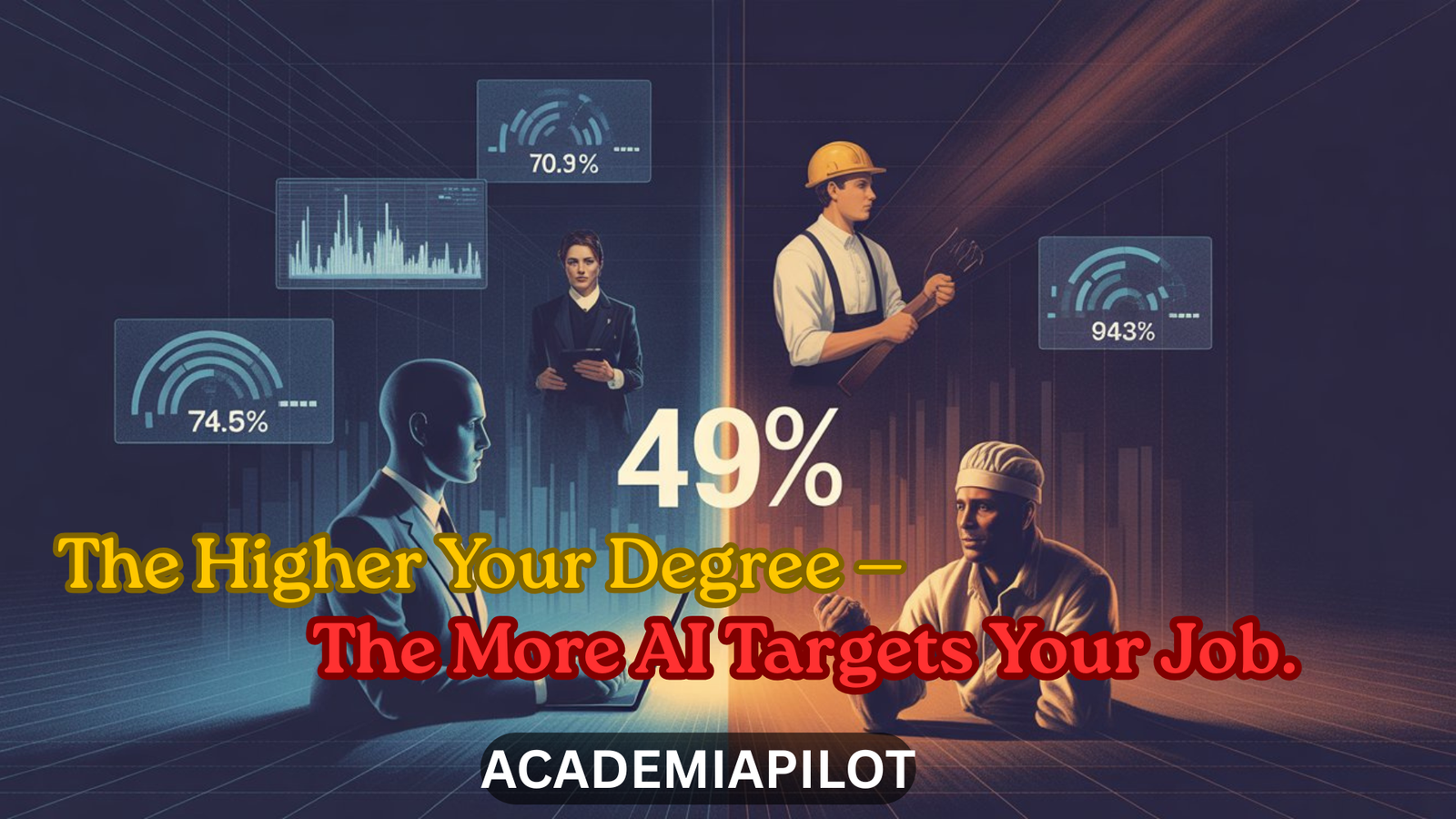
Key Takeaways — Quick Reference
- 49% of US jobs expose at least 25% of tasks to AI — up from 36% a year ago
- 74.5% observed AI exposure for computer programmers — highest single occupation
- 30% of all workers show zero AI exposure (cooks, mechanics, bartenders, lifeguards)
- 94.3% vs 35.8% — theoretical capability vs observed deployment for computer/math: a 58-point gap
- The most exposed worker is older, 16 percentage points more likely to be female, earns 47% more, holds a graduate degree at 4× the rate
- 178,000 nonfarm payrolls added in March 2026, unemployment at 4.3% — no mass layoff signal
- 35% drop in entry-level job postings since January 2023 (Revelio Labs)
- 20% employment decline for 22–25-year-old software developers specifically (Goldman Sachs)
- 1.0–1.2% annual labor productivity growth from AI after reliability adjustment — down from the 1.8% gross estimate
- Users with 6+ months on Claude achieve a 10% higher task success rate and attempt harder work — AI proficiency compounds
- Peter McCrory, Anthropic head of economics: "AI is something you learn to do, not something that happens to you"
- Figure 7 in the original paper was corrected — labels for top quartile and zero exposure inflow rates were reversed in the original publication
The Inverted Pyramid of Risk
The workers AI is hitting hardest are the ones everyone told you to become.
Not the warehouse sorter. Not the truck driver. Not the fast food cashier whose job appeared on every "automation risk" chart in every McKinsey report since 2013. The workers with the most AI task exposure in 2026 are the ones who went to graduate school, the ones who work in offices, the ones who earn more than the national median, the ones who are older — and, in a finding that has barely registered in the coverage — the ones who are disproportionately female.
This is the central finding of a body of research that has grown considerably since its initial publication. Anthropic economists Maxim Massenkoff and Peter McCrory published their standalone labor market paper in early March 2026, followed by the Fifth Economic Index report on March 24, 2026 — titled "Learning Curves" — which added a dimension to the risk portrait that changes the individual career calculus entirely.
The five Economic Index reports and the labor market paper together constitute the most rigorous AI jobs research ever published. Not because of their conclusions, which are alarming enough, but because of their methodology. Every prior AI jobs analysis worked from theory: here is what AI could theoretically do to job tasks. Massenkoff, McCrory, and their colleagues at Anthropic are the first researchers to use data from actual AI usage: here is what Claude is actually doing in professional settings right now, across millions of real conversations, weighted by the degree to which it substitutes for human labor rather than supplements it.
Computer programmers have a 74.5% observed AI exposure rate. Customer service representatives: 70.1%. Data entry keyers: 67.1%. Medical record specialists: 66.7%. Market research analysts: 64.8%. These are not predictions. They are measurements.
The cooks, motorcycle mechanics, lifeguards, and bartenders at the other end of the distribution? Zero observed AI coverage. Their jobs require physical presence, manual dexterity, or real-time sensorimotor response that no LLM can replicate.
And the March 2026 BLS jobs report, released April 3, shows 178,000 nonfarm payrolls added and an unemployment rate unchanged at 4.3%. No mass layoffs. But entry-level job postings are down approximately 35% since January 2023. The impact is real and measurable — it is just operating through a mechanism most people are not tracking.
This is that full picture.
Top exposed occupations — observed AI coverage
US workforce exposure distribution
Why This Research Body Is Different — The Observed Exposure Methodology
Before the numbers can be interpreted, the methodology must be understood. The Anthropic research introduces a metric that no prior AI jobs research has had access to — and without understanding the metric, the numbers are easily misread.
What Prior Studies Measured
Every major AI jobs study before Massenkoff and McCrory — McKinsey's Future of Work, Oxford's 47% automation risk analysis, Goldman Sachs's 300 million jobs estimate — worked from the same methodological foundation: the ONET occupational database. ONET describes every occupation in the US economy as a list of tasks. Researchers coded those tasks as "AI-replaceable" or "not AI-replaceable" based on theoretical capability assessments, then summed exposed tasks to produce an exposure score for each occupation.
The problem: theoretical capability and actual deployment are not the same thing. Just because Claude can theoretically perform a medical coding task does not mean medical practices are deploying Claude to perform medical coding. The gap between capability and deployment is the measurement gap that every prior study has been unable to close.
What the Anthropic Research Measures
Massenkoff and McCrory introduced "observed exposure" — a measure derived from the Anthropic Economic Index, which analyzes millions of actual Claude conversations to identify what professional task categories AI is being used for in real deployments. The distinction between theoretical and observed exposure is made explicit in Figure 2 of the labor market paper: two overlapping regions — the blue area (theoretical capability) and the red area (observed usage) — for every major occupation category. The gap is enormous and persistent across every sector.
One methodological note that matters for interpreting all the data: Anthropic corrected Figure 7 in an update to the paper, which showed inflow rates for workers in the top quartile versus zero exposure groups, and had incorrectly reversed its labels in the original publication. The correction reverses the visual story for those inflow rates — researchers and commentators who cited the original Figure 7 were reading a mislabeled chart.
The Full Automation Weighting
The researchers weight fully automated AI use (through API integrations where AI completes tasks with no human in the loop) more heavily than cases where humans use AI as an assistant. This reflects the economic reality: when AI completes a task autonomously, the labor demand for that task is eliminated. When AI assists a human, the labor demand is reduced but not eliminated.
The weighting means the observed exposure numbers are measuring something closer to "AI is replacing task capacity" than "AI is a popular tool in this occupation."
The Complete Occupational Exposure Map
The Highest Observed Exposure Occupations
The five most exposed individual occupations in the Anthropic study:
Computer programmers: 74.5% — Nearly three-quarters of the task scope of computer programming is being addressed by AI in real professional deployments. This does not mean 74.5% of programming jobs are being eliminated — it means 74.5% of task categories are being AI-addressed in some form. The Fifth Economic Index found that coding tasks are specifically migrating from augmentative usage on Claude.ai toward automated workflows in the API, with 79% of Claude Code conversations classified as automation (vs. 21% augmentation). The direction of travel is toward higher automation, not lower.
Customer service representatives: 70.1% — The highest non-technical observed exposure. Customer service is primarily language-based, rule-following work — exactly the task profile that LLMs handle well. Anthropic's API data shows automated customer service workflows (payment and billing support, for example) are among the most prevalent use cases in first-party API traffic.
Data entry keyers: 67.1% — The most mechanically automatable occupation in the list. Claude shows proficiency in large swaths of data entry and database architecture work per the Economic Primitives report.
Medical record specialists: 66.7% — Healthcare administrative work — coding, record management, documentation — is a documented high-deployment area. Note: this is administrative healthcare work, not clinical work. Clinical roles have fundamentally different exposure profiles.
Market research analysts and marketing specialists: 64.8% — Synthesis, summarization, report generation, competitor analysis, and content production are all language-model-native tasks.
The Occupational Category Rankings
| Occupational Category | Theoretical AI Capability | Observed AI Exposure | Gap |
|---|---|---|---|
| Computer and Math | 94.3% | 35.8% | 58.5 pts |
| Business and Finance | 94.3% | 28.4% | 65.9 pts |
| Office and Administrative | 90.0% | 34.3% | 55.7 pts |
| Management | 91.3% | (moderate) | Large |
| Legal | 89.0% | 20.4% | 68.6 pts |
| Architecture and Engineering | 84.8% | (moderate) | Large |
| Arts and Media | 83.7% | 19.2% | 64.5 pts |
| Education and Library | ~82% | 18.2% | Large |
| Sales | (high theoretical) | 26.9% | Large |
The floor occupations — theoretical capability below 20%:
| Category | Theoretical Coverage |
|---|---|
| Ground Maintenance | 3.9% |
| Transportation | 12.1% |
| Agriculture | 15.7% |
| Food and Serving | 16.9% |
| Construction | 16.9% |
| Personal Care | 18.2% |
| Installation and Repair | 18.4% |
| Production | 19.0% |
The 30% of workers with zero AI coverage are concentrated in these categories: jobs requiring physical presence, real-time sensorimotor response, or environmental variability that no language model can replicate.
Theoretical capability vs observed deployment gap
The Counterintuitive Finding — Why High-Skill, Older, Female Workers Are Most Exposed
This section receives the least analytical attention in mainstream coverage — and is arguably the most important finding for anyone making a career decision in 2026.
Profile of most AI-exposed worker
The Profile of Maximum Exposure
The most AI-exposed group in the Anthropic research:
- Is more likely to be older
- Is 16 percentage points more likely to be female than the least exposed group
- Earns 47% more on average than the least exposed group
- Is nearly four times as likely to hold a graduate degree compared to the least exposed group
The profile of maximum AI exposure is not the low-wage physical worker. It is the highly educated, experienced, well-compensated knowledge worker — the lawyer, the financial analyst, the software developer, the market researcher, the medical administrator.
Why Knowledge Work Is More Exposed Than Physical Work
The mechanism is straightforward once stated: AI is fundamentally a language and reasoning system. The tasks it can perform are tasks that can be represented in language — described, specified, and executed through text. Knowledge work is, by definition, work primarily conducted through language: analyzing documents, drafting communications, synthesizing information, generating code, creating reports, reviewing contracts, building financial models.
Physical work — construction, agriculture, food preparation, personal care, transportation — requires the worker to be physically present in an environment that varies in ways no model can predict from text alone. Physical work's exposure floor is not policy — it is physics.
The Gender Dimension
The 16-percentage-point female exposure gap arises from the occupational distribution of women in the US workforce: women are overrepresented in administrative, clerical, customer service, data entry, and medical record occupations that show the highest observed AI exposure. The occupations with the lowest AI exposure — construction, transportation, agricultural work, installation and repair — are male-dominated.
As of April 2026, approximately 79% of employed women in the US hold positions categorized as high-risk for AI automation, versus 58% of men, per ALM Corp analysis citing PwC and IMF data.
The Education Inversion
The four-times graduate degree premium in AI exposure is the sharpest departure from the standard automation narrative. The economic model that generated the advice "get a college degree, you'll be safe from automation" was built on the observation that routine, codifiable, low-skill tasks were most susceptible to computerization. LLMs break this model: they replicate — imperfectly but at scale — the synthesis, drafting, analysis, and research functions that previously required graduate-level training.
The counterintuitive nuance from the Economic Primitives report: Claude successfully completes college-level tasks 66% of the time vs. 70% for tasks requiring less than a high school education. But the productivity speedup scales more sharply with complexity — college-level tasks get a 12× speedup vs. 9× for high school level tasks. AI is most useful where human capital is highest — and therefore most likely to change what that human capital is worth.
The Employment Paradox — High Exposure, Stable Unemployment, Collapsing Entry-Level
The most important interpretive challenge in the Anthropic research is a tension that coexists with the April 3 BLS report: if observed AI exposure is high and increasing, why has no systematic unemployment increase been detected?
What the March 2026 BLS Data Shows
The March 2026 BLS Employment Situation report (released April 3, 2026) showed total nonfarm payroll employment increased by 178,000 in March and the unemployment rate remained at 4.3%. Job gains occurred in healthcare, construction, and transportation and warehousing. Federal government employment continued to decline.
The existing workforce is not being fired. No AI-driven mass unemployment wave has materialized in the aggregate employment statistics as of April 2026.
The Mechanism: Hiring Compression, Not Firing
The evidence that explains the apparent paradox: entry-level job postings are down approximately 35% since January 2023, per Revelio Labs data cited by CNBC. Goldman Sachs data shows that among 22–25-year-olds in AI-exposed roles, employment fell 16% from late 2022 to mid-2025. Among young software developers specifically, the decline was nearly 20%.
Companies are not using AI to fire their existing workers. They are using AI to avoid hiring new workers. The workforce reduction is happening at the entry point — through attrition, vacancy non-replacement, and deliberate reduction of entry-level headcount — not through terminations of experienced employees.
The Anthropic paper itself frames the possible scenario explicitly: a "Great Recession for white-collar workers," noting that during the 2007–2009 financial crisis the US unemployment rate doubled from 5% to 10%. The researchers note that a comparable doubling in the top quartile of AI-exposed occupations — from 3% to 6% — would be clearly detectable in their framework. It has not happened yet. But the paper names it as the scenario to watch.
The Cohort Effect: Entering vs. Exiting
The researchers offer several interpretations for the young worker data beyond simple displacement: workers not hired may be remaining at existing jobs, taking different jobs, or returning to school. Some young workers exit the labor force rather than appear as unemployed, because many are labor market entrants without a listed occupation — a statistical invisibility that standard unemployment measures do not fully capture.
The structural consequence: experienced workers retain positions as long as institutional knowledge and relationship capital remain valuable. New graduates face a structurally tighter entry-level market that does not show up in unemployment statistics because the workers who would have been hired never received those offers in the first place.
Dario Amodei, Anthropic's CEO, stated in his "Adolescence of Technology" essay and in subsequent interviews that AI could disrupt roughly 50% of entry-level white-collar positions within five years. That prediction is not in the Massenkoff/McCrory data — it is a forward projection. But the early indicators in the data — declining job postings, slowing young worker hiring, the gap between theoretical capability and current observed deployment — are consistent with a trajectory toward that outcome if the observed-theoretical gap continues to close.
Amazon's AI Coding Emergency: A Production Signal
One of the most concrete proxies for AI's early production impact appeared in the Financial Times in early April 2026: Amazon called an emergency meeting of its engineers to investigate a series of recent outages partly attributed to AI coding tools. An internal memo cited a "trend of incidents" with a "high blast radius" connected to "novel GenAI usage for which best practices and safeguards are not yet fully established." One outage knocked Amazon's website and shopping app offline for nearly six hours after an erroneous AI-assisted software deployment.
This is not evidence that AI cannot code. It is evidence that the deployment of AI coding at scale — without the governance and validation infrastructure to match — is producing the kinds of production failures documented in our Vibe Coding in Production guide. It also signals the real-world boundary of AI's current autonomous coding capability: the task exposure is high, but the reliability is still insufficient for fully unsupervised production deployments at the companies with the highest standards.
The Opportunity Gap — What the 58-Point Spread Means for Careers
The most actionable finding in the Anthropic research is the enormous gap between theoretical AI capability and observed AI usage.
Computer and math: 94.3% theoretical, 35.8% observed — a 58.5-point gap. Legal: 89% theoretical, 20.4% observed — a 68.6-point gap. Business and finance: 94.3% theoretical, 28.4% observed — a 65.9-point gap.
As the paper states: AI "is far from reaching its theoretical capability" and "actual coverage remains a fraction of what's feasible." But the Fifth Economic Index adds an important update to how to read that gap: it is closing, and it is closing unevenly.
The Learning Curve Dimension
The Fifth Economic Index report — "Learning Curves," published March 24, 2026 — introduces findings that change the individual career calculus from the original paper.
Users with six months or more on Claude achieve a 10% higher task success rate than newer users. This gap persists even after controlling for task type, model selected, country, and use case. But the finding that is most consequential for career planning is not the success rate difference — it is what experienced users are doing with their additional success: they are attempting harder, more complex work.
In the March data, each additional year of Claude usage correlates with approximately one additional year of schooling in the education level required to understand the user's prompts. Experienced users are not doing the same work faster. They are doing different work — harder work, work that extracts more value from the same underlying technology.
Peter McCrory told Fortune on April 7, 2026: "A lot of the public discussion treats AI as something that happens to you. The learning curves data suggests instead that it is something you learn to do." That distinction is the core of the career response this data implies.
The Productivity Estimate Revision
The January 2026 Economic Primitives report introduced an important correction to Anthropic's prior productivity estimate. The gross estimate — 1.8 percentage points of annual labor productivity growth from widespread AI adoption over ten years — was replicated even with API data added. But when adjusted for task reliability (the probability that a given task is actually completed successfully), the estimate falls:
- Claude.ai tasks: 1.8% → 1.2% per year (about one-third reduction)
- API tasks (harder problems): 1.8% → 1.0% per year (slightly larger reduction)
Even 1.0% annual productivity growth would be notable — it would return US productivity growth to the rates of the late 1990s and early 2000s. But the revision matters for anyone reading AI productivity forecasts: the gross capability number overstates the realized economic impact by roughly one-third due to task failure rates.
The Task Value Signal
The Fifth Economic Index introduced another useful data point: the average hourly wage associated with Claude.ai tasks slipped from $49.3 per hour in January 2025 to $47.9 per hour in February 2026 — still well above the US average hourly wage of $37.3. The report attributes the decline primarily to growth in simpler factual queries from casual users following Anthropic's Super Bowl advertising campaign, not a structural retreat from high-value work. On the API side, average task value has risen consistently, reaching $50.7 per hour in February 2026.
This split — Claude.ai task value declining as the user base broadens, API task value rising as enterprise deployment deepens — is the leading indicator that professional AI usage is bifurcating into two populations: casual tool users and serious professional adopters whose task complexity (and AI proficiency) compounds over time.
The SHIFT Framework — Career Strategy Built from the Data
SHIFT: Skills Hardening → High-Gap Task Identification → Identify Your Floor → Forward Exposure Mapping → Tenure and Learning
Skills Hardening
Build irreplaceability in the Gap Tasks. Focus on physical presence, relationship capital, ethical accountability, and novel problem decomposition.
High-Gap Task ID
Map your specific exposure. Isolate the tasks in your role that resist text-specification or lack full automation workflows to find your growth window.
Identify Your Floor
Know the minimum observed exposure roles. Evaluate adjacent pivots toward physical presence or relationship primacy to drastically reduce exposure.
Forward Exposure Mapping
Read the theoretical ceiling, not just today's observed floor. Track tasks currently performed by AI in leading-edge organizations as deprecating assets.
Transition Runway
Act on the 14% entry-level hiring drop timeline. New entrants have zero runway; existing workers have a 5–10 year window to build gap-task expertise.
S — Skills Hardening: Build Irreplaceability in the Gap Tasks
The gap between theoretical and observed AI capability is where human expertise currently concentrates — but it is not static. The appropriate response is not to rest in the gap but to harden expertise in the tasks that are hardest to close even as AI deployment deepens.
The categories of tasks that consistently require human involvement even in highly AI-deployed occupations: tasks requiring physical presence or real-world action (legal courtroom representation, site assessments, hands-on procedures), tasks requiring institutional knowledge and relationship capital (client trust, internal political judgment, organizational history), tasks requiring ethical accountability (medical decisions, legal strategy, financial fiduciary judgment), and tasks requiring novel problem decomposition at the edge of current AI capability — which the Economic Primitives data shows is where AI success rates decline most sharply.
Claude successfully completes tasks requiring a college degree 66% of the time — meaning it fails 34% of the time on college-level work even with experienced users. Those failure modes are the gap. Expertise concentrated in the tasks where AI reliability is lowest is the most durable expertise.
H — High-Gap Task Identification: Map Your Specific Exposure
Category-level data is the starting point, not the end point. The 35.8% observed exposure for computer and math occupations is an average across all sub-occupations and work contexts in that category. A programmer building security-critical systems for a government contractor has a fundamentally different exposure profile than a programmer generating standard CRUD application code.
The individual exposure mapping exercise: list your 10 most common task types in a typical week. For each, ask: (1) Can this task be fully specified in text? (2) Is this task already being performed by AI tools in my organization or field? (3) Does this task require institutional knowledge unique to my organization, or physical presence? (4) Is this task in a workflow where full automation would require the organization to retool entirely?
The gap between items 1 and 2 is your personal opportunity window.
I — Identify Your Floor: Know the Minimum Exposure Roles
If your current occupation shows high observed exposure and you are in a career transition window, the occupational data provides a map. Within knowledge work, the roles with the lowest observed AI exposure as of April 2026:
- Education: particularly positions requiring physical classroom presence and real-time student interaction
- Legal: courtroom representation and strategic advisory (explicitly named in the paper as beyond AI's reach)
- Healthcare: clinical judgment roles — diagnosis, treatment planning, patient communication
- Complex B2B relationship sales where trust and personalized negotiation are the primary value drivers
- Management roles requiring cross-functional political judgment and exception-driven decision-making
Movement toward physical presence, relationship primacy, ethical accountability, or novel judgment reduces exposure. Movement away from those properties — toward more routine cognitive production — increases it.
F — Forward Exposure Mapping: Read the Theoretical Ceiling, Not Just Today's Floor
The most common career planning error the data reveals is calibrating to today's observed exposure rather than the theoretical ceiling. The 35.8% observed exposure for computer and math occupations is the current state. The 94.3% theoretical capability is the ceiling toward which deployment is moving.
The Fifth Economic Index adds a specific forward indicator: tasks are migrating from augmentative Claude.ai usage to automated API workflows as organizations mature their AI deployments. Coding tasks showed this pattern most clearly. The occupations where this migration is most advanced are the leading indicators for where migration will reach next.
Identify the tasks in your field that are currently being automated at the leading-edge organizations in your sector. Those tasks will reach your organization within 3–5 years. Treat them as depreciating assets in your skill portfolio. Identify the tasks that even leading-edge organizations are not automating — tasks requiring the longest human-alone time estimates — and treat those as appreciating assets.
T — Tenure and Learning: The Compounding Return to Early Adoption
The learning curve finding is the most underreported element of the entire research program: users with 6+ months on Claude achieve 10% higher task success rates and attempt harder, higher-value work. The returns to AI proficiency compound with experience. Early adopters are not just more productive — they are developing the tacit knowledge of when to direct and when to defer, when to trust the output and when to interrogate it, that no tutorial can replicate and that becomes increasingly valuable as AI deployment deepens.
Peter McCrory told Fortune: "I really felt the role of expert evaluation is really important." He described his own experience using Claude for econometric analysis: Claude would run models, sometimes incorrectly, and McCrory's expertise allowed him to identify the error and direct iteration. That human-AI collaboration dynamic — expert evaluation guiding AI execution — is the skill the learning curve data shows compounds with tenure.
The career implication: start using AI tools in your professional context now, not after the market forces you to. The difference between a 3-month user and an 18-month user is not just familiarity — it is the 10% task success differential and the qualitative shift toward harder, more complex, more valuable work. That differential is the moat.
For workers in high-exposure occupations: the transition runway for existing workers is 5–10 years before structural headcount reduction reaches current employees. That runway is most productively spent developing AI fluency — not as a hedge against displacement, but as the investment that puts you in the compounding group rather than the lagging group.
The Policy Vacuum — What Isn't Happening
As of April 2026, no significant federal policy response to the AI labor market findings has materialized. President Trump signed an executive order overriding state AI laws and reaffirmed a deregulatory stance via his AI Action Plan, which encourages an industry-led approach to AI governance. The administration has introduced a national AI framework that appears to prioritize AI capability development over AI labor market protection.
The Korn Ferry research from late 2025 found more than 40% of companies planned to replace existing roles with AI — particularly back-office (58%) and entry-level (37%) positions. EY's late 2025 research found that only 17% of organizations experiencing AI-driven productivity gains reduced headcount — most reinvested. But the reinvestment is predominantly in AI infrastructure and senior talent, not in retraining the displaced entry-level population.
The World Economic Forum's Future of Jobs report projects 92 million jobs displaced by 2030, offset by 170 million new roles — a net gain of 78 million. The analytical problem with this framing, as the Anthropic team would put it: it conflates aggregate gains with individual outcomes. The 170 million new roles will not automatically go to the 92 million displaced workers. The reskilling infrastructure — workforce training programs, community colleges, employer upskilling budgets — is far behind the pace of displacement.
There is no AI equivalent of the Trade Adjustment Assistance programs built for manufacturing job losses. There is no policy infrastructure designed specifically for the hiring compression pattern the data reveals. The workers most immediately affected — new graduates trying to enter AI-exposed fields through entry-level positions that no longer exist at the same rate — have no dedicated support structure.
Common Mistakes Professionals Make When Reading AI Jobs Data
Confusing theoretical capability with observed deployment. A finding that AI can theoretically perform 94.3% of tasks in computer and math occupations does not mean 94.3% of programmers' jobs are being eliminated tomorrow. It means deployment will rise toward that ceiling as organizations mature their AI investments. The distinction is the most important interpretive distinction in all AI jobs research.
Treating category-level data as individual-level data. The 35.8% observed exposure for computer and math is an average. A programmer building novel security systems has a fundamentally different profile than a programmer generating standard forms. Category-level data informs the range of risk; individual role analysis determines where in that range you sit.
Calibrating to current observed exposure rather than the theoretical ceiling. The observed figures are a snapshot. The theoretical figures are the ceiling toward which deployment will move. Workers whose current role sits in the gap between observed and theoretical are in the trajectory zone, not the safe zone.
Interpreting stable unemployment as absence of impact. The 35% decline in entry-level job postings since January 2023, the 14–20% employment decline for young workers in AI-exposed fields — these are real impacts that do not appear in headline unemployment statistics because they operate through vacancy non-replacement rather than termination.
Ignoring the Figure 7 correction. Anthropic corrected Figure 7 in the original paper — the inflow rate chart for the top quartile versus zero exposure groups had reversed labels. Anyone citing the original chart's conclusion about which group is entering or exiting AI-exposed occupations at higher rates should verify they are reading the corrected version.
Using "upskill" as a complete career response. The Fifth Economic Index's learning curve finding makes this even more obviously insufficient: the compounding benefit of AI proficiency with tenure means the career response is not "acquire a skill" — it is "start now and let the compound returns do the work." An 18-month tenure advantage in AI tool proficiency is not acquirable in a weekend course.
Treating the counterintuitive inversion as temporary. The finding that highly educated, older, better-paid workers are most exposed is structural. It reflects the fundamental property of LLMs as language-and-reasoning systems that substitute for cognitive-linguistic work. As AI capability improves, the substitution pressure on knowledge work increases, not decreases.
Strategic Conclusion: The Measurement Finally Caught Up to the Moment
Every prior AI jobs study was a thought experiment. If AI can theoretically do X% of the tasks in occupation Y, how many workers are at risk? The Anthropic research program is the first that is not a thought experiment. It is a measurement — updated five times since 2025, with each edition adding a new analytical layer to the picture.
The findings invert the standard narrative twice. First: the workers most exposed are not the least educated and least paid — they are the most educated, most experienced, highest paid. Second: the impact is not showing up in unemployment statistics — it is showing up in hiring, where the entry-level pipeline into knowledge work is being compressed at a rate that aggregate employment numbers cannot capture.
And now a third finding from the learning curves research inverts the expected career response: the workers who will benefit most from AI are not the ones who wait to adopt it when forced. They are the ones whose AI proficiency compounds with tenure — who are, today, attempting harder work than their less-experienced peers, extracting more value from the same underlying technology, and building the tacit knowledge of expert evaluation that no benchmark can replicate and no late adopter can shortcut.
Peter McCrory, whose team produced all of this research, said it most directly in the Fortune interview published April 7, 2026: AI is something you learn to do, not something that happens to you.
The SHIFT Framework is not about avoiding AI. It is about reading its deployment trajectory accurately — what is closing and what is not, what the theoretical ceiling implies about the observed floor's trajectory, where the compounding of AI proficiency with tenure creates durable advantage — and placing your expertise accordingly.
The March 2026 BLS report says employment is stable. The learning curves report says early adopters are already in a different labor market from late adopters. Both are true simultaneously, today. The divergence is widening.
Frequently Asked Questions
Common questions about this topic